
Unlocking Equine Dentistry:
A Feature with Dr Elizabeth Thompson DVM
(aka Lizzi Tremayne)
When Dr Elizabeth Thompson flew into the Sunshine Coast for a brief mid July visit from her base in New Zealand, it was a rare chance to sit down with one of the most accomplished equine dental specialists in the world, just as her new book Modern Equine Dentistry for Horse Owners hit the shelves. Here’s everything APH readers need to know.
Know the Author
A 1988 graduate of UC Davis School of Veterinary Medicine with a postgraduate membership in equine dentistry (MANZCVS Equine Dentistry, Australia, achieved 2007), Dr Thompson runs the Blue Mist Equine Veterinary Centre, providing referral level dental care across horses, ponies, minis, donkeys, zebras, alpacas and even white rhinos. She lectures veterinarians in dental techniques, designs her own portable stocks (Equi Still Portable Equine Stocks, marketed internationally), and publishes fiction under the name Lizzi Tremayne, winning multiple awards for historical and veterinary storytelling.
Her veterinary articles earned the prestigious Jonathan Hope Award for Best Practitioner Publication in both 2010 and again in 2023.

What’s in the Book
Modern Equine Dentistry for Horse Owners, released in June 2024, is written for everyday horse owners seeking to understand what’s going on in their horse’s mouth and why good dentistry matters for comfort and performance. Part textbook, part owner’s manual, it unlocks modern techniques, diagnostic levels, and practical signs to watch for in reader friendly language.
The Levels of Equine Dentistry
Dr Thompson explains that equine dentistry operates on a clear continuum, starting with the most basic care and moving toward highly advanced diagnostic capabilities. At the foundation is the use of only a hand float, a simple tool to remove sharp enamel points and minor malocclusions, often described as prophylactic “floating,” essential to everyday comfort and digestion. Some practitioners still employ a one‑sided gag, though Liz cautions that these offer very limited visibility and compromise both safety and effectiveness. The next step up is the full‑mouth speculum, which holds the mouth open securely and facilitates safer and more comprehensive access.
Once the mouth is open, debris is flushed out, and illumination is introduced with an inter‑oral light – usually under sedation, supported by a head‑stand or specially designed dental halter – to ensure both practitioner and patient comfort and clarity of view. The examination then continues with mirrors, probes, and picks, tools that allow for close inspection of occlusal surfaces, periodontal gaps, and other hidden areas. From there, the standard is elevated by introducing oroscopy (oral endoscopy), which she regards as a benchmark for high-quality dental care: it enables direct visualisation of internal surfaces that would otherwise remain unseen/
Finally, for the most complex or elusive issues, she notes, advanced diagnostics such as CT, MRI, or ultrasound may be employed. CT imaging in standing sedated horses now provides three‑dimensional views of teeth, pulp horns, sinuses, and bone architecture, vastly improving precision in identifying fractures, apical infections, or infundibular caries. MRI offers soft‑tissue detail and is especially helpful around periodontal structures, though its use is limited by availability and the need for full general anesthesia.
Together, these eight tiers, from hand float to advanced imaging, offer horse owners a clear roadmap to understanding what level of dental care their horse is receiving and where gaps might exist if a more thorough assessment is needed.
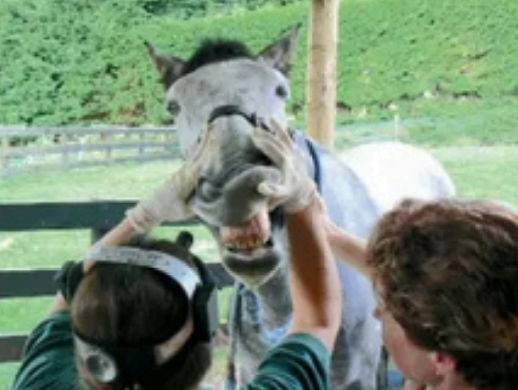
How to Spot a Horse That Needs Dental Attention
During work:
- Pulling or lugging on one or both reins
- Resisting turns
- Head tossing
- Subtle, unexplained lameness
- Mouthing or chewing the bit
- Head tilt, tongue sticking out or over the bit
- Resisting bridling
- Sensitive cheeks
In the paddock:
- Dropping grain or “quidding” (wads of hay or grass)
- Excessive saliva or drooling
- Foul odour from the mouth
- Head tilt while grazing
- Hard feed in water bucket
- Tongue play
- Whole grains in manure
- Refusing to eat (or slow eating)
- Weight loss (usually only in severe disease)
- Facial swelling, purulent discharge
Liz’s Diverse Veterinary Experience
While interviewing Liz in person, it became clear that her range is exceptional. She has treated horses, donkeys, minis and zebras and even performed advanced dental care on white rhinoceroses and alpacas during her referral practice years. That breadth, she says, gives her an unparalleled understanding of anatomy, behaviour and the creative solutions needed in challenging situations.
Why You Should Read Her Book
Whether you’re a competitor, a trainer, or simply a devoted horse owner, Modern Equine Dentistry for Horse Owners offers a clear and comprehensive guide to one of the most overlooked aspects of equine health. The book breaks down dental anatomy, common diseases, and treatment options in straightforward language, helping readers truly understand what’s happening inside their horse’s mouth. It also provides valuable insight into what best practice looks like from a horse-first perspective, empowering owners to make informed decisions about their horse’s care. With guidance on how to choose a qualified dental professional, a detailed explanation of the eight levels of dental service, and practical checklists of warning signs to watch for, this book is a powerful tool for anyone who wants to ensure their horse stays comfortable, healthy, and performing at their best. For APH readers, it’s nothing short of essential.